







Scary Good Deal—or Just Scary?
Sept. 22, 2026

How to Spot Fake Halloween Costume & Décor Deals
You found it: the costume that’s been all over your feed. Normally $89.99, but somehow it’s $9.99 today only.
Or maybe it’s a 10-foot animated yard monster with glowing eyes, realistic movement and free shipping…for less than dinner.
Your first thought: Add to cart.
Your second thought should probably be: Wait. What?
Halloween shopping can already get expensive, which makes a huge discount tempting. Unfortunately, scammers know that too. Fake online stores, misleading social media ads and suspiciously cheap costumes and decorations can turn a spooky-season bargain hunt into a financial horror story.
And this isn’t just a Halloween problem. The Federal Trade Commission reported that in 2025, nearly 30% of people who reported losing money to a scam said it started on social media. Shopping scams were the most commonly reported type of social media scam, with more than 40% of people who lost money to a social-media scam saying it began after they ordered something advertised there.
So before you give that mysterious Halloween store your credit card number, watch out for these deal jump scares.
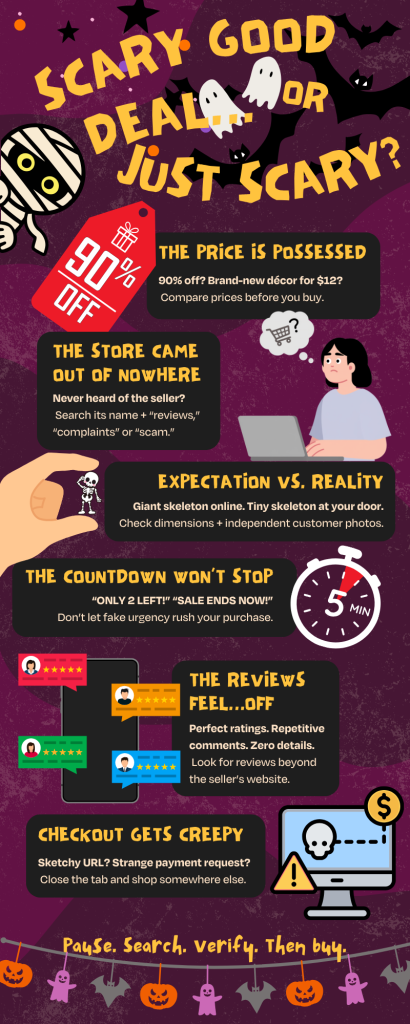
👻 Jump Scare #1: The $10 Costume That Costs $80 Everywhere Else
A huge discount feels like winning Halloween.
90% OFF! CLEARANCE! TODAY ONLY!
But extreme discounts are also an easy way to get shoppers to act before they think.
The FTC warns that scammers sometimes impersonate legitimate companies on social media and advertise brand-name products at unusually low prices. Shoppers who follow the link may end up on a fake website and receive a cheap counterfeit, something completely different—or nothing at all.
Try this instead: Take a quick minute to search for the same costume or decoration elsewhere. If every reputable retailer has it for $70 and one mystery website wants $9.99, that price deserves some investigating.
🕸️ Jump Scare #2: The Store That Appeared Out of the Fog
The website looks great. There are professional photos, glowing reviews and a giant BUY NOW button.
But who actually runs it?
Fake storefronts can look surprisingly convincing these days. Before ordering, look for working customer service information, a clear return policy, information about the business itself and their social media presence.
Then leave the website and search the business name along with terms such as “reviews,” “complaints” or “scam.”
This is especially important if you arrived through an ad. In August 2026, the FTC reminded consumers that social media ads aren’t always thoroughly vetted by the platforms displaying them.
A professional-looking ad isn’t proof that the company behind it is trustworthy.
💀 Jump Scare #3: Your Giant Skeleton Is Suddenly…Tiny
Expectation: a massive animated skeleton duo ready to become the main attraction of the neighborhood.
Reality: something that belongs to a dollhouse.
That example isn’t completely made up. The Better Business Bureau has warned about misleading holiday décor advertisements where shoppers receive products that are dramatically different from what was pictured—or receive nothing at all. In one report highlighted by BBB, a shopper expecting two large animated skeleton decorations instead received two tiny skeletons about eight inches tall.
Before buying décor from an unfamiliar seller, look closely at product dimensions, specifications and customer photos from independent sources. Reverse-image searching a suspiciously impressive product photo can also help you see whether the image was copied from somewhere else.
🧛 Jump Scare #4: The Countdown Timer That Won’t Let You Think
SALE ENDS IN 09:58!
ONLY 2 LEFT!
53 PEOPLE ARE VIEWING THIS!
Maybe.
Urgency is powerful because it makes you focus on getting the deal rather than checking the deal.
Don’t let a countdown clock make a decision for you. Leave the site, research the seller and come back if everything checks out. A legitimate purchase should survive a five-minute reality check.
🧟 Jump Scare #5: The Reviews Are Suspiciously Perfect
⭐⭐⭐⭐⭐
“AMAZING!!! BEST COSTUME EVER!!!”
⭐⭐⭐⭐⭐
“LOVE IT!!! FAST SHIPPING!!!”
⭐⭐⭐⭐⭐
“AMAZING!!! BEST COSTUME EVER!!!”
Wait a minute…
Reviews shown on a seller’s own website shouldn’t be your only source of information. Search elsewhere for independent feedback. Look for specific details, a realistic mix of ratings and reviews that span more than a suspiciously short period.
And remember: a polished website, convincing photos and enthusiastic comments don’t automatically make a seller legitimate.
🦇 Jump Scare #6: The Checkout Page From the Underworld
You made it to checkout—and now the seller wants you to pay in a way that feels…off.
That’s your cue to leave.
The FTC recommends paying by credit card when possible because federal protections may allow you to dispute certain charges when something goes wrong. It also warns consumers about online sellers that insist on payment using gift cards, wire transfers, payment apps or cryptocurrency.
Also check the URL before entering payment information. A misspelled brand name, strange domain or URL that doesn’t match the company you thought you were shopping with deserves extra scrutiny.
🎃 The 30-Second Costume Check
Before you tap Buy Now, give the deal one last inspection:
- PRICE: Is it dramatically cheaper than everywhere else?
- SELLER: Have you researched the business independently?
- URL: Does the web address look legitimate?
- REVIEWS: Can you find feedback somewhere other than its own website?
- CONTACT: Is there a real way to reach customer service?
- RETURNS: Can you easily find and understand the return/refund policy?
- PAYMENT: Does the checkout method offer purchase protections?
If several answers make you uncomfortable, abandoning your cart could be the best deal you get all day.
If the Deal Turns Out to Be a Trick
If you paid for something that never arrived or believe you encountered a fraudulent seller, contact your financial institution or card issuer as soon as possible to discuss your options.
You can also report suspected scams to the Federal Trade Commission’s ReportFraud.gov. If you believe your personal information was stolen or misused, the FTC also provides recovery guidance through IdentityTheft.gov.
Because the scariest thing you bring home this Halloween shouldn’t be a fraudulent charge. 👻
Scary Good Deal—or Just Scary?
Scam Alerts
Sept. 22, 2026

Your Portland Passport to National Hispanic Heritage Month
Community
Sept. 8, 2026